Back in 2002, to establish a baseline, a nationally-representative forest inventory plot network (the Land Use and Carbon Analysis System, LUCAS) was created by the Ministry for the Environment, to measure forest biomass and carbon storage. This national forest inventory consists of over 1,000 permanent measurement plots on an 8 km grid across Aotearoa’s pre-1990 natural forest and shrublands, including indigenous tall forest on or near public conservation land. The plot network is augmented and backed by increasingly sophisticated satellite data on land-cover, but nothing beats on-the-ground fieldwork.
By 2017, when the plots were re-measured, no overall national change was detected in carbon storage in forests, but subsequent more detailed analyses suggested a decline in carbon in the widespread indigenous kāmahi-podocarp forest type. Such loss of carbon, if continued over the long-term, could have major implications for New Zealand’s carbon balance.
In kāmahi-podocarp forests, many canopy tree species are browsed by non-native mammals. Because of this, it was suggested at the time that controlling browsing mammalian herbivores, particularly deer, goats and brushtail possums (Trichosurus vulpecula), might reverse biomass declines in these forest classes and increase carbon storage.
But were possums and other browsers really the culprits? Could browser control benefit carbon storage? Enter the carbon detectives from Manaaki Whenua - Landcare Research, armed with world-leading expertise in landscape ecology and data interpretation, large rolls of fencing wire, and a lot of patience.
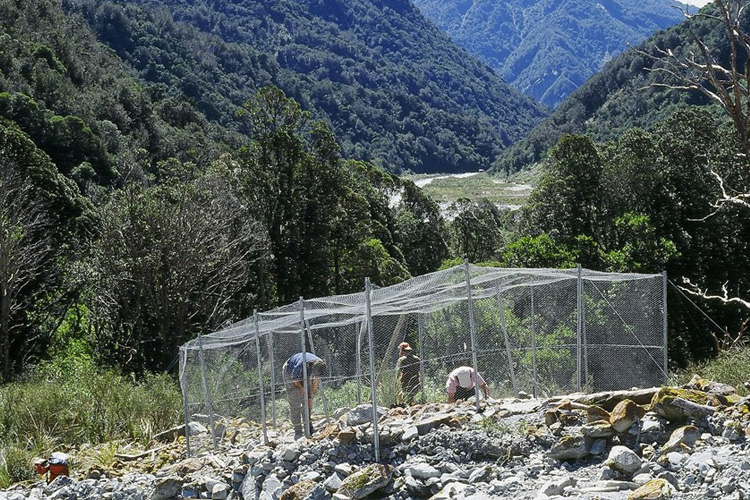
Animal exclosure
Their work had two complementary aspects: desk-based number crunching, and more of the all-important fieldwork. For the former, Manaaki Whenua’s researchers undertook a comprehensive re-analysis of the plot network data for the Department of Conservation. Completed in 2025, the analysis showed that in fact, there was no large-scale effect of herbivore-driven carbon declines in indigenous tall forest on public conservation land. Effects were slight, but not major, partly because deer, goats and possums browse their preferred foods but avoid other plants, so a well-established, mixed forest type can stand up well to browsing and no overall decline is noted.
Overall, the re-analysis showed that there was virtually no change in carbon stocks in living plant stems across all plots nationwide (the actual average change across the whole country was -0.0005 milligrams of carbon per hectare per year).
Out in the field, the fencing wire and the patience were deployed in a remote part of Westland back in 2014. Wire cages were set up in the Kokatahi river catchment to exclude possums from a regenerating floodplain, and the resulting patterns of plant succession were patiently measured over the following 11 years. Perversely, at the end of the experiment, plant succession was more advanced outside the cage, where possums removed competitive herbs and grasses from the plant assemblage, allowing woody species to grow more rapidly and hence store more carbon.
Combining the results, was there a final reckoning in The Case of the Missing Carbon? Overall, the researchers conclude that the argument for managing browsers to improve carbon outcomes is weak. The slight effects of browsing animals on carbon stocks are significantly outweighed by the effects of other, larger, landscape-scale processes such as landslides, soil erosion, floods, fire, and windthrow caused by storm events, which all have much more pronounced effects on forest structure and health.
The work also shows that principles of carbon accounting such as permanence (durable removal of carbon from the environment) and additionality (attributable net change in carbon from a baseline) are very difficult to track in real life. Meanwhile, forest browsers still need managing, for other important reasons. Management of browsers has significant benefits for biodiversity on conservation land and elsewhere, and control of possums is also vital to reduce TB infection in livestock.