Two countries in the Pacific, Papua New Guinea (PNG) and the Solomon Islands, recently held workshops to determine their top priority weeds for biocontrol. Both countries are home to some of the world’s richest biodiversity, but their unique flora and fauna and ecosystems are being threatened by invasive weeds. These weeds are also invading food gardens, croplands and pastures, making it more difficult to grow food. Waterways are also invaded, which affects activities such as recreation and transport, through to health and traditional practices.
Biological control of weeds in PNG has an excellent track record, with PNG previously a regional leader in the use of natural enemies to suppress invasive weeds. Over the years 19 biocontrol agents have been released there to target species such as broomweed (Sida spp.), chromolaena (Chromolaena odorata), giant sensitive plant (Mimosa diplotricha), lantana (Lantana camara), mile-a-minute (Mikania micrantha), pig weed (Mimosa pigra), puncture vine (Tribulus cistoides), salvinia (Salvinia molesta), and water hyacinth (Pontaderia crassipes).
Over the past decade PNG’s progress in weed biocontrol has stalled due to shifting national priorities and constrained funding. However, there is a desire to reignite this work with support from the BSI’s Natural Enemies – Natural Solutions (NENS) programme, which is part of the Pacific Regional Invasive Species Management Support Service (PRISMSS). With climate change making invasive weeds worse, biocontrol is a key way to increase the resilience of Pacific communities and ecosystems.
In September the BSI undertook a scoping mission and facilitated a one-day National Stakeholder Workshop in Port Moresby in PNG, hosted by the Department of Agriculture and Livestock (DAL). The workshop brought together 30 participants from eight key organisations, including DAL, National Agriculture Research Institute, Conservation and Environment Protection Authority, University of PNG, Binatang Research Centre, youth awareness groups Eda Davara and Mastermind, and the Women and Youth in Agriculture network.

Image: participants at the recent workshop in PNG.
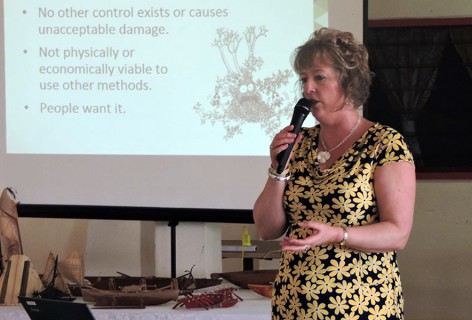
PRISMSS NENS technical lead for the Pacific, Lynley Hayes said, “The level of engagement and enthusiasm at the workshop was tremendous and we thank DAL for their support and extend our gratitude to all the organisations that participated in this event. We look forward to working with them in the future.”
“This workshop was an important step in reconnecting partners, reviewing previous work and prioritising weeds for future biocontrol action,” added NENS coordinator Annette Mwayawa of the BSI.
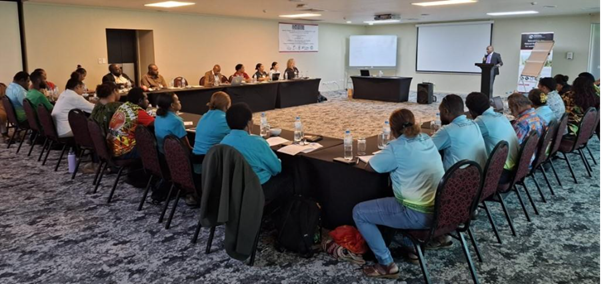
Image: the PNG workshop in action.
A weed prioritisation tool was used to identify the most important weeds for NENS in PNG. The top six weeds identified were: pig weed (Mimosa pigra), mile-a-minute (Mikania micrantha), African tulip tree (Spathodea campanulata), Koster’s curse (Miconia crenata), spiked pepper (Piper aduncum), and molasses grass (Melinus minutiflora). These are a mix of novel targets and those for which natural enemies are readily available. Australia has a well-developed programme for pig weed, and the NENS programme is well placed to assist with African tulip tree agents.
The Solomon Islands also has a history of releasing weed biocontrol agents. Prior to the 2000s the Solomon Islands intentionally released seven biocontrol agents for weeds such as giant sensitive plant, Koster’s curse, lantana, and water hyacinth. Since then, work on biocontrol has waned, but as in PNG there is renewed interest in restarting with the support of the NENS programme.
A prioritisation workshop was held last December in Honiara in the Solomon Islands to identify priority weeds for biocontrol. This event was hosted by the Environment and Conservation Department of the Ministry of Environment, Climate Change, Disaster Management and Meteorology (MECDM). Twenty key stakeholders from various environmental organisations attended, including the Secretariat of the Pacific Regional Environment Programme (SPREP), MECDM, the Ministry of Forest and Research, Biosecurity Solomon Islands, Barana Community Nature Heritage Park, Mai-Maasina Green Belt, Live & Learn Solomon Islands, Solomon Islands Rangers Association, Ecological Solutions Solomon Islands, and Solomon Islands Climate Action Network.
As in PNG, this workshop facilitated discussions on the potential use of natural enemies for weed management, the willingness of stakeholders to use this approach, and the feasibility of introducing natural enemies in the region. “There was again strong interest and commitment from the various organisations in implementing biocontrol strategies for managing invasive plants. Participants expressed enthusiasm for using biocontrol agents, and Biosecurity Solomon Islands reaffirmed their support, particularly for weeds impacting agricultural production due to high labour costs,” said Chantal Probst, a researcher from the BSI, who helped run the workshop.
The weed prioritisation tool determined the top five priority weeds for NENS in the Solomon Islands to be: water hyacinth, African tulip tree, mile-a-minute, chromolaena, and Bengal clockvine (Thunbergia grandiflora). Three of these weeds, including African tulip tree, are low-hanging fruit since there are agents readily available. A weevil (Neochetina eichhorniae) has been released against water hyacinth in the Solomon Islands, but another weevil (Neochetina bruchi) is available in Australia and Vanuatu and prefers older leaves, so it could complement the attack of N. eichhorniae, which attacks younger leaves. Agents for chromolaena are also available in Australia.

Image: water hyacinth before biocontrol.
These workshops in PNG and the Solomon Islands, and the discussions held before and after, highlight a strong interest and commitment across a range of stakeholders for using natural enemies once again to control invasive plants in both these countries. The next step is to secure funding to allow work to begin against the priority weeds. By joining the PRISMSS NENS programme, these countries will join eight other Pacific countries already receiving support, such as technical expertise, capacity building, and scaling up proven biocontrol solutions to empower their communities to take local action against invasive weeds.
The Restoring Island Resilience project, which supported this work, is funded by New Zealand’s Ministry of Foreign Affairs and Trade and administered by the Secretariat of the Pacific Regional Environment Programme (SPREP). Under the umbrella of the Pacific Regional Invasive Species Management Support Service, which is hosted by SPREP, the Bioeconomy Science Institute leads the Natural Enemies – Natural Solutions programme, which provides support to Pacific Island countries and territories to restore ecological balance using safe, targeted biocontrol agents from the weeds’ native ranges.