The weed biocontrol team recently visited several release sites to check whether the field horsetail weevil (Grypus equiseti) has established. Signs of plant damage were detected back in 2023, but until now the agent itself had never been found at the field sites. This spring the team’s efforts finally paid off: adults and eggs were found at all four monitored sites, confirming establishment.
Field horsetail (Equisetum arvense), which is native to Eurasia, has a limited distribution in New Zealand but can form major infestations in damp environments such as river margins, stream edges, poorly drained fields, and sandy and gravelly areas, including roadsides and rail tracks, where it can form pure stands outcompeting and excluding other vegetation. The plant grows an extensive root system made up of deep rhizomes and tubers, often reaching more than two metres underground. Common herbicides cannot penetrate deep enough to kill the entire root system, making it challenging and costly to control.
The plant spreads naturally via spores produced in early spring, which can travel long distances. Floodwaters and gravel movement have also contributed to its accidental spread, with the potential for much wider distribution. In the South Island, infestations of field horsetail can be found in Marlborough, Tasman, the West Coast, northern Canterbury, and Dunedin. In the North Island, isolated infestations have been recorded in Hawke’s Bay, Gisborne, Taranaki, and Greater Wellington, and it has become well established and widespread in the Manawatū-Whanganui Region, particularly on the floodplains of the lower Rangitīkei River.
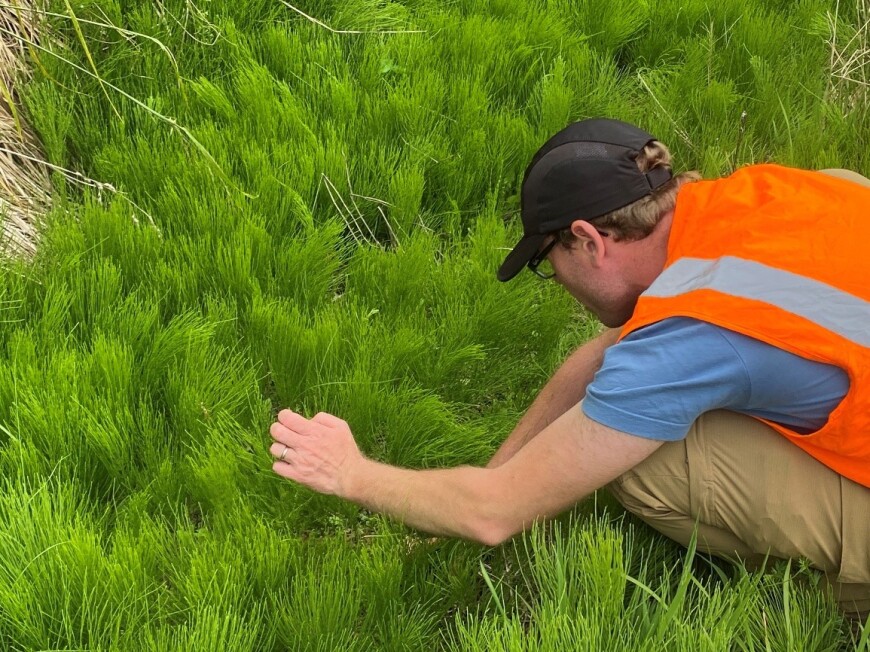
Image: Arnaud searching field horsetail for weevils.
The field horsetail biocontrol journey started more than 18 years ago when Horizons Regional Council funded the BSI weed biocontrol group to investigate the feasibility of targeting field horsetail for biocontrol. Among the numerous natural enemies found in the native range of field horsetail, a stem-mining weevil stood out as the most promising. After gaining EPA approval for release, the weevil was introduced in Manawatū-Whanganui in 2017. Adult weevils feed on and lay their eggs in the stems of field horsetail by making distinctive oviposition holes. The larvae then tunnel down through the stem, killing all above-ground material before mining into the root system, reducing the plant’s ability to regenerate the following season.
Mass-rearing the weevil was at first constrained by the physical stature of field horsetail stock plants. However, with significant improvements to the mass‑rearing protocol more than 6,500 weevils have been released across multiple sites since 2017. Numbers ranged from a few hundred to more than 1,000 per site, but confirming establishment proved difficult. The weevil is small, the host plant is dense, and disturbance of horsetail plants causes adult weevils to drop instantly to the ground and enter thanatosis – a defensive immobility that can last several minutes. “Searching for them sometimes felt like trying to find a needle in a haystack,” said Arnaud Cartier, senior technician, who has overseen the mass‑rearing since 2020. “And when they drop and play dead, you often don’t see them again, even in the rearing colony, so locating adults in the field proved particularly challenging.”
In summer 2022/23, senior technician Paul Peterson visited all release sites, and although some damage looked consistent with weevil activity, there were no sightings of any life stage of the agent.Fast forward to November 2025, when Arnaud, accompanied by biosecurity officer Robbie Sicely (Horizons Regional Council) and Paul, revisited several sites together, this time with conditions looking far more promising. “We were hoping the timing was finally right to catch the weevils red‑handed,” Arnaud explained. Before long the team noticed dead field horsetail stems and, sure enough, by gently dissecting them the search party found eggs in almost every single dead stem at all sites. Further, to their delight adult weevils were observed feeding, eliminating any remaining doubt: the weevil had indeed successfully established!
Although it is still too early to know the full impact the weevil will have on field horsetail, the team are optimistic. “If populations continue to build, we expect to see significant damage over time,” Arnaud said. “This could really help reduce the size and vigour of infestations.”
This project was funded by the National Biocontrol Collective and the Ministry for Primary Industries’ Sustainable Farming Fund, administered by the Lower Rangitikei Horsetail Control Group. Mass rearing and releases are funded by Horizons Regional Council and Environment Canterbury.