The team in the BSI have been exploring options for biocontrol of giant reed (Arundo donax) in both the Pacific and New Zealand, but success remains elusive. Giant reed is a tall, woody, Eurasian grass that now occurs in tropical, subtropical, and warm temperate regions on all continents except Antarctica. It has been introduced to many countries and territories in the Pacific region, including the Cook Islands, the Federated States of Micronesia, Fiji, French Polynesia, Hawaii, Nauru, New Caledonia, Palau, Samoa, Tonga, and Wallis and Futuna.
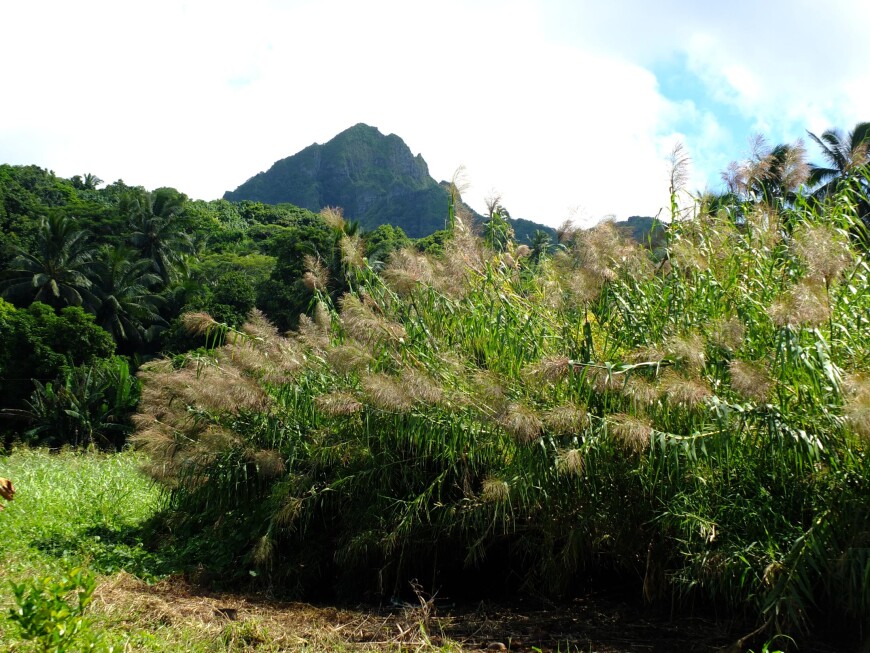
Image: giant reed in Rarotonga.
Giant reed is sterile and propagates by stem or rhizome fragments, which establish readily. In riverine areas plant fragments can be dispersed rapidly during floods. Elsewhere, human activities such as plantings for stabilising earth on embankments and ornamental garden planting are a major source of infestations.
Giant reed can cause severe ecological disruption by displacing other vegetation and forming dense monocultures, reducing floral and faunal diversity. It can also alter ecosystem services by increasing fire risk, and, in drier regions, by depleting valuable water reserves. Riverine infestations can also restrict the size of river channels, causing floods and damage to infrastructure.
“Giant reed first attracted our attention as an invasive weed in the Pacific region in 2012,” said Quentin Paynter, a BSI researcher who took part in a scoping study to prioritise weed biocontrol targets in the Cook Islands. “It ranked highly because of its perceived importance by stakeholders in Rarotonga, and because damaging biocontrol agents had already been developed for it, making it a relatively inexpensive target with a seemingly excellent chance of success.”
Two biocontrol agents, sourced from France and Spain, have been established in the USA and Mexico to control giant reed since 2009: a gall wasp, Tetramesa romana (Walker), and an armoured scale insect, Rhizaspidiotus donacis (Leonardi). A third agent, a leaf-mining fly, Lasioptera donacis Coutin, failed to establish. “The gall wasp and scale insect have been correlated with a significant decline in giant reed and the recovery of native flora at release sites in Texas,” Quentin noted.
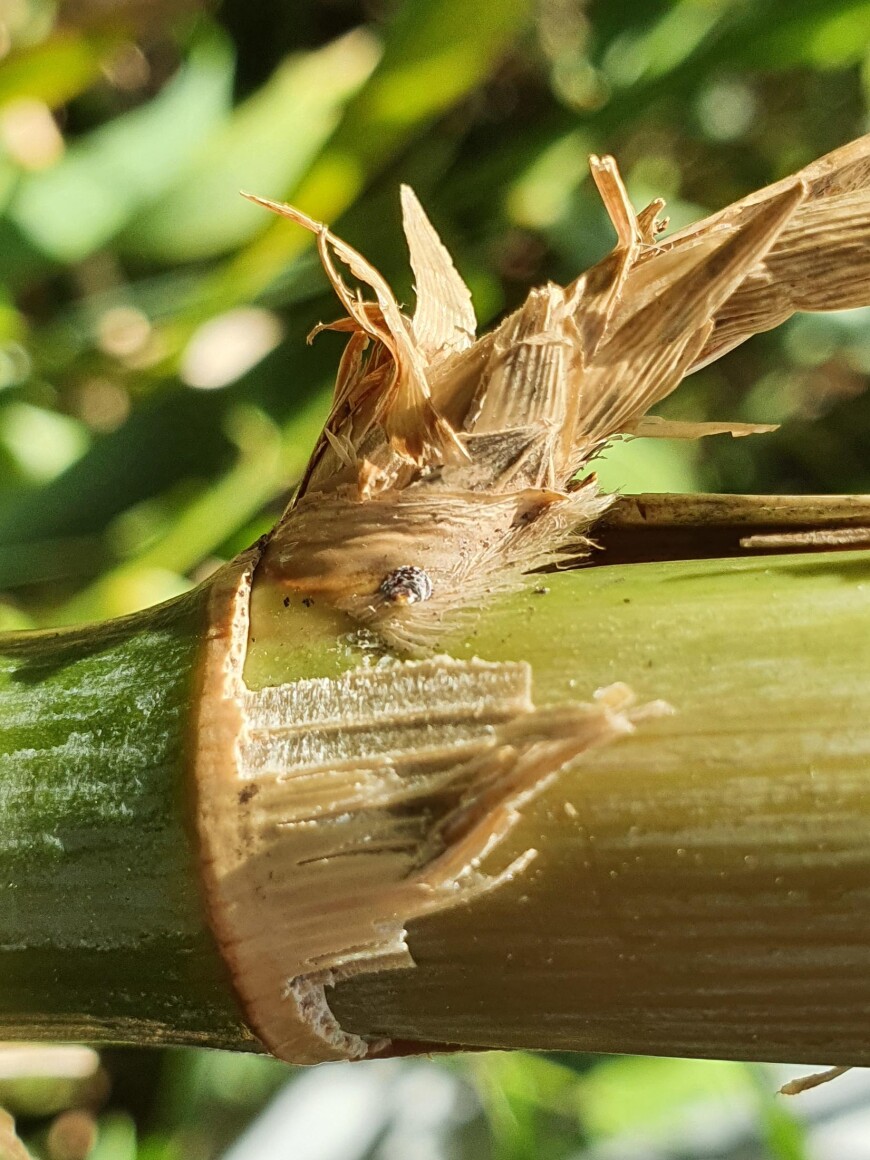
Image: scale insect on giant reed stem.
A shipment of the gall wasp and scale insect was obtained with the assistance of Dr John Goolsby, a US Department of Agriculture research entomologist based in Texas, and rearing commenced in anticipation of approval to release them in Rarotonga. However, things didn’t turn out as planned. “During a visit to Rarotonga to survey potential release sites we hit a snag – we couldn’t find any giant reed!” said Quentin. It turned out that what had been assumed to be giant reed infestations were actually another tall invasive grass called elephant grass (Cenchrus purpureus). “We eventually located a small giant reed patch, but it was restricted to one property and the consensus was the infestation was eradicable, so it wasn’t worth the effort of releasing biocontrol agents,” Quentin added.
In New Zealand, giant reed occurs in scattered populations on both main islands. Impacts are currently localised but have the potential to become much worse. “It seemed a shame to dispose of the agent cultures that we had imported from Texas,” said Quentin. “Luckily, the National Biocontrol Collective agreed to support an application to release the agents in New Zealand, with Northland Regional Council as the applicant.”
Host specificity testing already conducted in the USA was extensive and no further testing was required for the gall wasp, and only a handful of native grasses required testing to demonstrate that the scale insect was also adequately host-specific to be released in New Zealand. Environmental Protection Authority approvals were obtained, and the gall wasp was first released in 2017 and the scale insect in 2021.
“Signs have not been promising since then,” said Quentin. “A year after releases were made, we found a stem with a couple of gall wasp exit holes at one site and we recovered the scale insect from one plant at another site, but last year we couldn’t find signs of either agent at two Auckland release sites.”
The heavy clay soil at both sites may be unsuitable for the scale insect, which mainly infests the rhizomes. “The soil becomes waterlogged after heavy rain and can be rock hard in summer, although I would still expect to see scale insects on the root collars,” said Quentin. “If we can find giant reed infestations on lighter soils – ideally sandy soils – to release the scale on it might be informative,” he added.
Several scientific studies conducted since the agents were released offer alternative explanations of why agents have failed to thrive in New Zealand. One study found that gall wasp damage in North America was strongly correlated with growing degree days, with warmer climates favouring higher gall wasp damage than cooler areas. Quentin noted that “Based on this study, we hypothesise that the climate in Auckland may be too cool for the gall wasps to thrive and inflict significant damage on giant reed infestations,” adding that “the wasp only attacks developing shoots, so stems maturing during cool periods when wasps are inactive will escape attack. Consequently, even if it does establish, we might expect attack rates in New Zealand to be very low.”
Although the gall wasp might be expected to perform better in warmer tropical Pacific countries, there’s another factor to consider. Invasive giant reed populations do not produce viable seeds and had been assumed to belong to a single sterile clone. Recent molecular studies, however, have identified several genotypes. The invasive genotype in the USA and Mexico originates from the Mediterranean region, where the biocontrol agents were sourced from. In laboratory tests, genetically matched gall wasps from the same region produced more offspring on the Mediterranean genotype compared with other wasp genotypes, indicating that genetic matching may be crucial to success. The Mediterranean genotype of giant reed is known to occur in New Caledonia, but the genotypes in New Zealand and Fiji have recently been matched to plants native to the Himalayas and China.
“Although we successfully reared generations of gall wasps on New Zealand plants, the plant biotype here may be a suboptimal host and, given the wasp is parthenogenetic (meaning it can reproduce asexually), it may struggle to adapt to it. That, combined with the suboptimal climate in New Zealand, might have been too big a hurdle for the gall wasp to overcome,” said Quentin.
“It would be costly to survey for agents in the Himalayas and China, where we know New Zealand and Fijian plants originated, and the origin of most giant reed populations in the Pacific region is unknown, so we don’t yet know the extent to which potential mismatches between agent and weed genotypes might influence biocontrol success,” said Quentin. Consequently, we think releases of biocontrol agents sourced from Texas could proceed to combat giant reed in the Pacific region, in tandem with a genetic analysis to determine the origin of giant reed populations, provided stakeholders are willing to accept the risk that the agents that worked well in Texas might not work so well in the Pacific.
The work on the feasibility of giant reed biocontrol for the Pacific was funded by the New Zealand Ministry of Foreign Affairs and Trade, and the work on giant reed in New Zealand was funded by the National Biocontrol Collective.