In July 2025 the Environmental Protection Authority (EPA) approved the release of the Darwin’s barberry rust fungus (Puccinia berberidis-darwinii) and the Darwin’s barberry flower weevil (Anthonomus kuscheli) as biocontrol agents for the invasive shrub Darwin’s barberry (Berberis darwinii). Approval for the flower weevil was first granted in 2012 but later lapsed. We had taken a wait-and-see approach, first monitoring the performance of the fruit-feeding weevil (Berberidicola exaratus) released in 2015, before deciding whether to introduce the flower weevil as well. Project funding for re-collection and release of the flower weevil has not yet been prioritised.
Only a small number of fungal pathogens have been released for weed control in New Zealand. These include the mist flower pathogen (Entyloma ageratinae) in 1998, two lantana rusts (Puccinia lantanae and Prospodium tuberculatum) in 2015, the tradescantia yellow leaf spot fungus (Kordyana brasiliensis) in 2018, and, most recently, the Chilean needle grass rust (Uromyces pencanus) in 2024. These represent only 7% of the total 70 weed biocontrol agents released in New Zealand, the rest being made up of arthropod biocontrol agents, specifically insects and mites. The recent approval of the Darwin’s barberry rust expands this select group and highlights the growing role of pathogens in weed biocontrol.
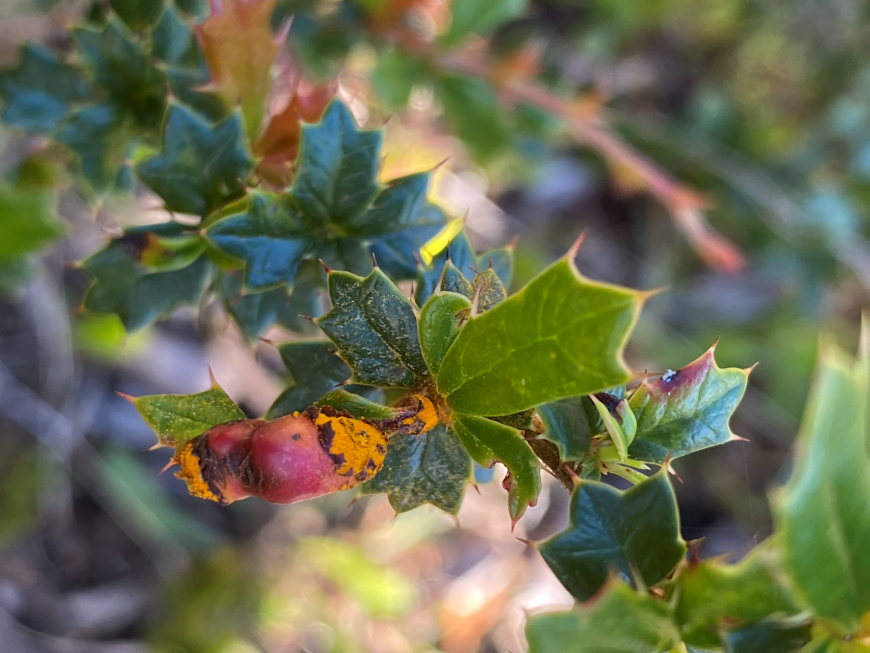
Image: gall with rust spores on Darwin’s barberry.
Darwin’s barberry is a woody, evergreen shrub native to southern Chile and Argentina. Originally introduced to New Zealand as an ornamental because of its striking bright orange flowers, it has since become a serious invasive weed. The plant produces abundant berries that are readily eaten and spread by birds, forming new infestations. Once established, Darwin’s barberry develops dense, spiny thickets that suppress native vegetation, restrict access, and can dominate large areas of forest margins and conservation land.
The development of the Darwin’s barberry rust as a biocontrol agent has been a long and technically challenging process. In its native range the rust produces visible yellow to orange spores (aeciospores) only for a short period, typically from October to December, infecting both leaves and fruits. The rust was first imported into the Beever Plant Pathogen Containment Facility in Auckland in 2014 as dried specimens collected from multiple sites across southern Chile. These samples were used for molecular studies to confirm that only a single rust species is associated with Darwin’s barberry, that rusts found on neighbouring barberry species are distinct, and that the rust is not related to known crop pathogens, including cereal rusts.
In June 2015 we received our first shipment of live rust into our Tamaki containment facility, supplied on detached leaves and on plants. Unfortunately, inoculations of plants in the facility did not result in infections, marking the beginning of a series of attempts to successfully infect Darwin’s barberry with the rust to establish a laboratory culture.
A breakthrough finally came in 2017 when Lindsay Smith returned from Chile with rust-infected fruits. We realised that the number of spores contained in fruits was extremely high compared to leaves and more likely to result in infection. A small number of pustules developed, just enough to maintain the culture, although progress was slow as the rust can take around 90 days to produce new spores.
To enable host-range testing, further imports of infected fruit were required. Shipping plant material proved unreliable, with delays, loss of viability, and mould contamination. “Hand‑carrying fruit from Chile turned out to be the most dependable method,” said Chantal Probst, a researcher in plant pathology. In 2019 around 1,000 infected fruits were collected near Valdivia and used to begin host-range testing. This work was interrupted by Covid-19 travel restrictions and resumed only in 2022, once international travel became possible again.
An EPA application was submitted in February 2025, followed by a hearing in June. Approval to release the rust and the flower weevil was granted in July 2025. By this stage, extensive host-range testing had reduced the amount of rust available in containment. This shortage was exacerbated when ventilation fans in the containment facility failed during the summer of 2025, further slowing rust production.
”We didn’t lose the culture, but rebuilding sufficient quantities in containment alone would have taken much longer than ideal,” said Chantal. To ensure the rust would be ready for field release, senior technician Zane McGrath travelled to Chile in December 2025 to collect fresh infected material. This will allow sufficient rust to be available for the first planned releases in September 2026.
While collecting infected fruits in Chile, Zane and our collaborator, Dr Hernan Norambuena, observed leaf galls on Darwin’s barberry that had not been recorded previously. These galls were formed by psyllids and, interestingly, were also infected by the rust fungus. The psyllids are likely to be host-specific and may represent a potential additional biocontrol agent. Further investigation would be needed, but this discovery highlights how ongoing exploration in a weed’s native range can continue to uncover new opportunities for biological control.
This project is funded by the National Biocontrol Collective.