Cordia alliodora, known as cordia or kotia in Tonga and Samoa, is increasingly recognised as an invasive weed of concern. Late last year the BSI weed biocontrol group began assessing whether this tree could be a suitable target for control. A feasibility study was prepared for the Secretariat of the Pacific Regional Environment Programme (SPREP) in response to rising concern in Tonga, but the scope covered all Pacific Island countries and territories.
Cordia is a large tree, native to Central and South America, introduced to the Pacific in the mid to late 20th century for forestry and agroforestry trials. Its tall, straight, self-pruning trunk makes it a valuable timber and attractive as shade tree in agriculture. However, harvesting in the Pacific has not kept up with the natural spread of the tree from the initial trial plots, and cordia is showing early signs of becoming a major problem.
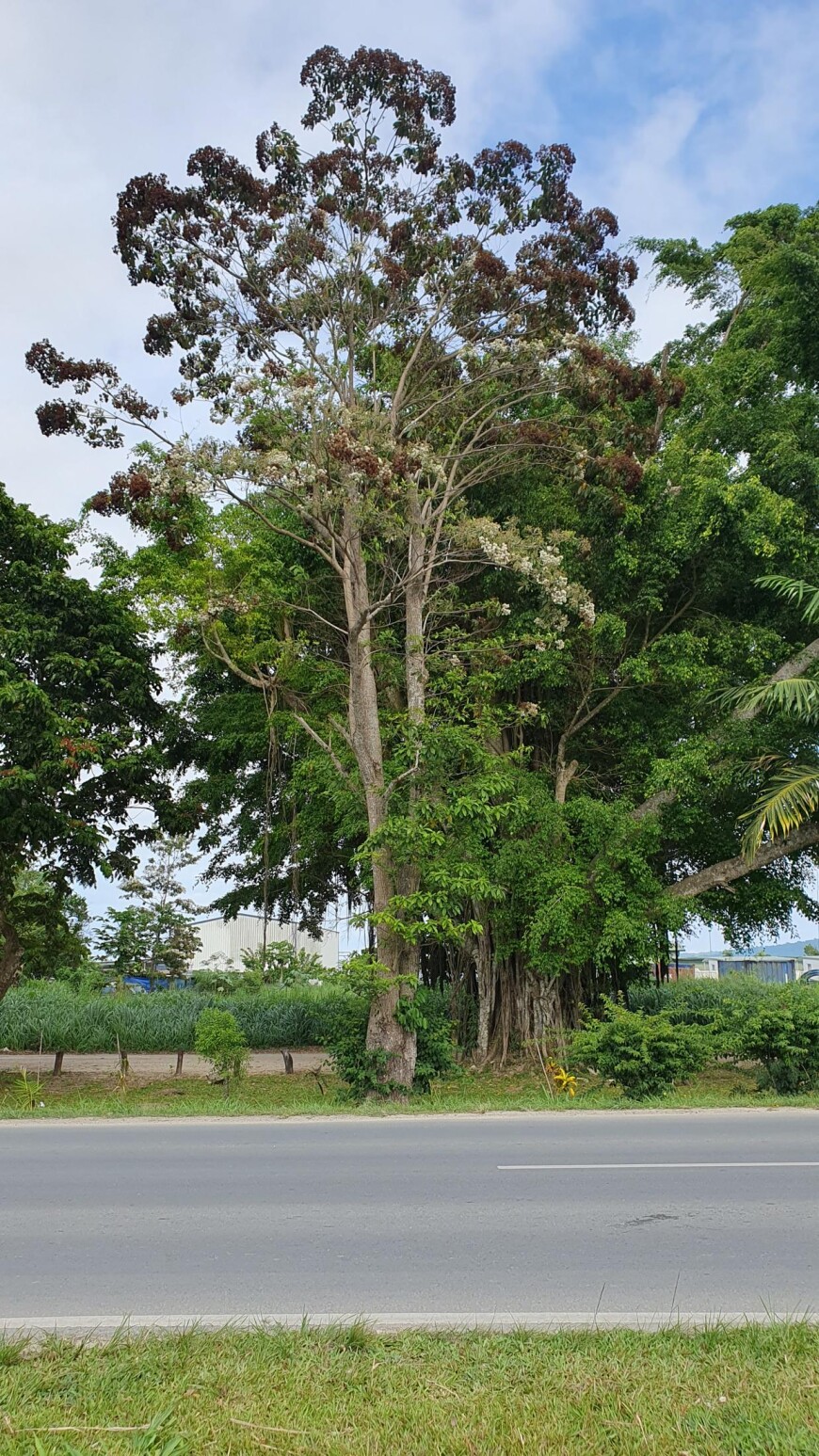
Image: flowering cordia in Vanuatu.
The cordia invasion is a prime example of how climate change is going to affect weeds in the Pacific. In 2012 a Category 4 severe tropical cyclone, named Evan, tore through the Pacific destroying landscapes in Samoa, Wallis and Futuna, Fiji, and, to a lesser extent, Tonga. In its wake cordia flourished, filling the gaps created in the forest at a rapid pace that the native forest trees could not compete with. Thirteen years later cordia is dominating parts of Tonga’s Toloa Rainforest Reserve and ‘Eua National Park, and Samoa’s Faleata Recreation Reserve.
Cordia’s rapid growth, high propagule pressure, and ability to rapidly colonise and dominate open, full-sun spaces make it highly competitive, enabling it to capitalise on the destruction caused by severe weather and spread fast to create monocultures that block out other species. These traits are shared by several other problematic weeds in the Pacific, including African tulip tree (Spathodea campanulata) and falcataria (Falcataria falcata), which are currently being worked on by the BSI’s weed biocontrol group. In Rarotonga, in the Cook Islands, African tulip tree’s brilliant orange flowers are now a regular sight, signalling the extent to which the trees are filling the slopes of the inner mountains and valleys in dense groupings, while falcataria’s umbrella-like canopy prominently juts out above the rest of the mountainside canopy.
As of 2024 African tulip tree and falcataria cover an estimated 1.6 % and 5.1% of the land area on Rarotonga, respectively. This might not sound like much, but, for example, despite its notoriety as one of New Zealand’s worst invasive weeds, gorse covers only approximately 3.6% of New Zealand’s land area, where it has been present for almost 200 years. African tulip tree was imported into Rarotonga approximately 100 years ago, and falcataria seeds were imported into Rarotonga in 1937. If these species are allowed to spread unchecked for another hundred years it could spell ecological disaster for Rarotonga.
With climate change it is expected that the intensity of cyclones will increase significantly. Severe cyclones can defoliate large areas of forest and cause landslides on mountain slopes, enabling more colonisation by weedy trees. Consequently, we can expect climate change to facilitate cordia becoming a dominant part of the landscapes in Tonga, Samoa, Vanuatu, and the Solomon Islands. Such large invasive trees can also become safety concerns. In 2014 tropical storm Iselle brought down thousands of trees onto homes, roads and powerlines in Hawaii, with falcataria accounting for 90% of fallen trees. This highlights the urgent need to find solutions for improved management of these weedy trees, including cordia.
At present cordia is being controlled manually in the Pacific through felling and chemical applications to kill the stumps. However, removing trees using these methods often creates large open areas in the canopy that are quickly reinvaded from seeds in the seed bank unless native species are actively replanted, increasing the labour and financial costs of effective control. Weed biocontrol is an attractive alternative: natural enemies could reduce the tree’s competitive ability, slowing its rapid establishment and growth. It is a low-risk, cost-effective, and sustainable alternative to herbicides and does not pose health risks to handlers.
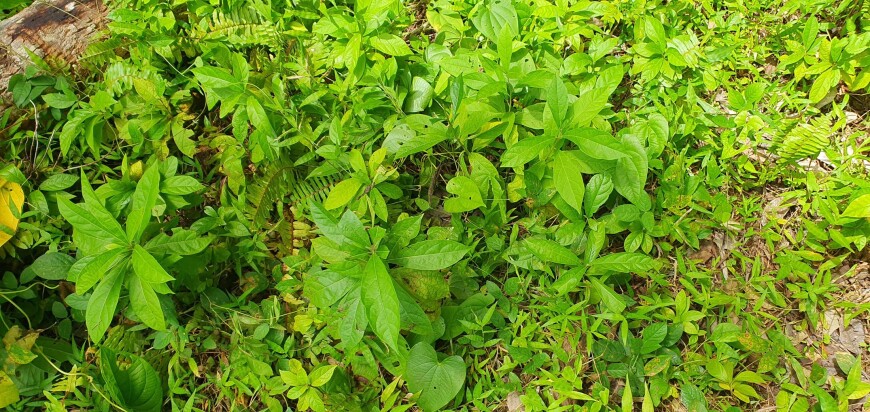
Image: cordia seedlings in Tonga.
The feasibility study reviewed the international literature for host records of organisms that are reported to be natural enemies of cordia, and resulted in an initial checklist of 171 arthropods, 32 fungal genera, one bacterium, and two mistletoes. “Not all of these species are likely to be specialists,” noted Dr Quentin Paynter, principal scientist in weed biocontrol based at the BSI Tamaki lab. “But the list is undoubtedly a fraction of the true number of natural enemies,” he added, pointing out that published arthropod and plant pathogen host records are often incomplete.
From the list two promising natural enemies were identified, for which host records indicate they may be highly host specific: a tortoise beetle (Coptocycla leprosa) that feeds on the leaves, and a fungal pathogen (Puccinia cordiae) that causes a variety of symptoms, including leaf pustules, witch’s broom, and canker. A moth (Stauropides persimilis) and a seed-feeding beetle (Amblycerus atkinsoni) may also be suitable candidates.
“Cordia alliodora is potentially a tricky target for biocontrol due to the presence of three Cordia species that are native to the Pacific region,” said Quentin. However, the literature clearly indicates that Puccinia cordiae has been reported to only attack a handful of closely related species that belong to the Gerascanthus section of the Sebestena clade, which does not include the Pacific natives (Cordia dichotoma, C. aspera, and C. subcordata). Moreover, the tortoise beetle has been reported to only attack (and sometimes totally defoliate) cordia.
“We know that rust fungi and tortoise beetles can often be highly host specific,” Quentin noted, adding that “this gives me confidence that we can find an agent that is both damaging and sufficiently host-specific, and who knows what else is out there waiting to be discovered by conducting surveys in the native range of cordia.”
Further reading:
The Secretariat of the Pacific Regional Environment Programme (SPREP) administers the Pacific Regional Invasive Species Management Support Service (PRISMSS), and BSI is the PRISMSS partner that assists with the development of natural enemies for key widespread weeds. The feasibility study was an output of the GEF-6 Regional Invasives Project, funded by the Global Environment Facility, implemented by the United Nations Environment Programme and executed by SPREP. The project worked primarily in the Marshall Islands, Niue, Tonga, and Tuvalu, and has a regional component. Implementation of the GEF 6 RIP was supported by PRISMSS.