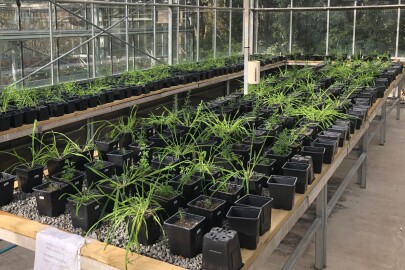
Pine seedlings growing in greenhouse
Compounding the problem, our researchers have recently discovered that introduced pines actually sow the seeds of their own future success, and that this is at least in part caused by altering soil biota in favour of themselves – a self-reinforcing feedback loop.
Their discovery came from a complex and painstaking experiment over three phases, with the first two phases aiming to create a range of soils “conditioned” by growing different plant communities. The experiment was designed to test whether abiotic soil conditions (e.g. pH, nutrients) and biotic soil conditions (e.g. invertebrates, fungi, bacteria) change depending on the plant community growing in the soil, with subsequent impacts on plant species that establish after the previous plant species (e.g. pines) has been removed.
The experiment began with a common field-collected soil. Phase 1 conditioned this soil by growing 39 plant species separately in individual pots – 19 native species and 20 non-native species – for around 10 months.
Next, the plants were harvested from the pots, with their roots chopped up and mixed back into the soil they were grown in. These phase 1 soils were then mixed together in 20 different combinations of eight species each to create soils with different histories. Next, a fresh set of 20 different plant communities, each with eight plant species, were planted in the pots. These plant communities either matched the mixed soils or differed entirely. They also varied in how many non-native species they included, with seven of the 20 plant communities including Pinus species (Pinus contorta and/or Pinus radiata). This was phase 2, which took 12 months.
By the end of phase 2, the researchers had 160 pots of soil with differing lengths of Pinus history (phase 1 and 2, phase 1 only, or phase 2 only) and a range of influences from other native and non-native plant species. These Phase 1 and Phase 2 treatments meant that the soils were conditioned to have a range of soil biology and chemistry.
For phase 3, soil samples were collected from the 160 phase 2 pots using sterilised trowels to avoid external microbial contamination. The samples were put into new, sterilised pots, and planted with Pinus contorta seedlings. These seedlings were grown for 6 months before their biomass was measured to evaluate whether the soil legacy of previous Pinus species or other non-native species influenced their growth. Root samples were also taken at the end of phase 3 to characterise fungal and ectomycorrhizal diversity using DNA. Ectomycorrhizal fungi form symbiotic relationships with Pinus (and other) plant species, helping them to access nutrients in exchange for carbon.
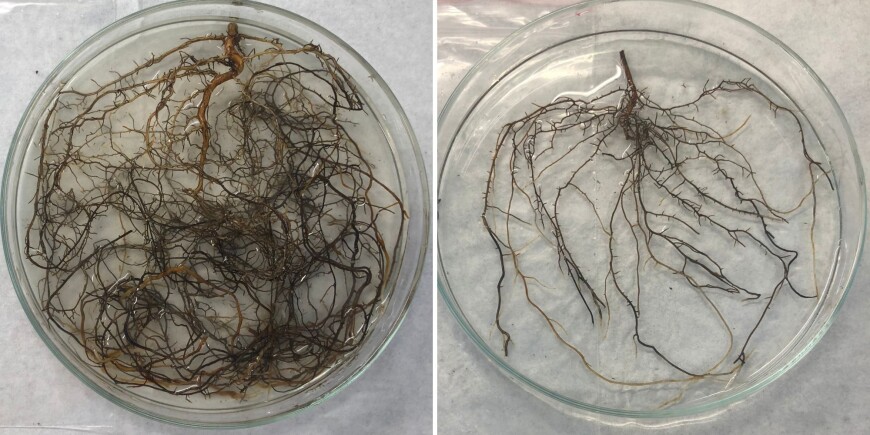
Pine seedling root trim. Left - pine seedling with pine legacy, and right, pine seedling without pine legacy.
The results were clear: Pinus contorta grew more vigorously in soils pre-conditioned by non-native plant communities. The fungal community on seedling roots in Phase 3 was influenced by a prior history of Pinus presence, which was associated with a lower diversity of fungi, and a higher proportion of ectomycorrhizal fungi in seedling roots. Seedlings with lower fungal diversity grew faster than those with higher fungal diversity, indicating that previous invasions by Pinus species may contribute to creating specialised soil fungal communities that facilitate further Pinus invasion.
The overall conclusion? Non-natives promote future non-natives, even after they have been removed. Occurrence of non-native plants, whether Pinus or not, increases the likelihood that future Pinus will establish and grow, and – worse – Pinus only needs a few months of soil conditioning to improve its chances of taking hold.
The researchers comment that this invaluable set of findings will inform future restoration efforts in pine invasion sites. Specifically, we cannot just manage wilding pines once and then walk away – reinvasion is more likely to succeed thanks to legacies of the initial invasion.