
Tool for cats: a non-lethal deterrent for nature reserves
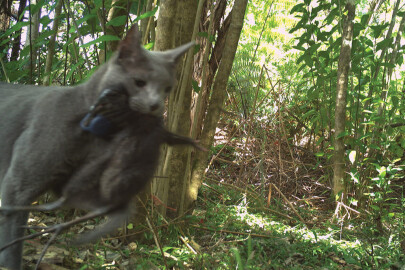 Playing sounds of the presence of people when a cat trips a motion detector camera in an urban nature reserve works to scare the cat away from the area and thus protects native birds. In trials, 66% of cats exposed to the human sound fled immediately, marking it as a useful non-lethal deterrent for household and feral cats, with potential for further investigation. Our wildlife ecologists’ work was also featured as a story in New Zealand Geographic in July (Not all cats | New Zealand Geographic), providing a channel for communication of their research findings on the impacts of owned domestic cats and the importance of problematic individuals to the general public, and continuing the public discussion of urban cat management issues.
Tunnel vision
Sze-Wing Yiu and Tom Etherington have demonstrated a proof-of-concept for using machine learning methods to distinguish between different rat species from their footprints collected via tracking tunnels. This study paves the way for further development of a fully automated footprint identification tool that will aid wildlife managers to monitor invasive predators in a cost-effective way. It is also a potential tool for identifying sites where kiore (Polynesian rat, Rattus exulans), a taonga species for some iwi, are found.
Read more:
Discriminating footprints to improve identification of congeneric invasive Rattus species
Unboxing problems of packaging waste
Gradon Diprose gave a presentation at the WasteMINZ conference in June 2025 on reusable packaging systems in the groceries sector. To date there has been no evaluation of the impacts of different packaging systems in New Zealand. The presentation outlined an innovative method to measure the environmental, socio-economic and cultural impacts of reusable packaging systems compared with single-use packaging systems in New Zealand’s groceries sector. The presentation and findings are relevant to a broad range of users, including producers, suppliers, retailers who operate packaging systems, consumers who buy grocery products, and local government operators of waste management facilities.
Flea beetle exceeding expectations in Pacific biocontrol
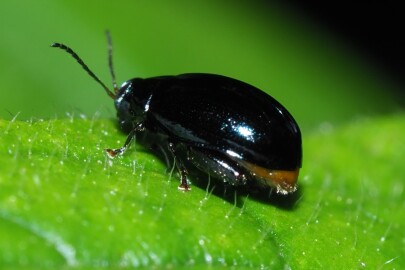
Flea beetle (Paradibolia coerulea)
Invasive weed species are the leading driver of biodiversity loss in the Pacific. Islands are particularly vulnerable ecosystems, and the list of invasive species is growing. African tulip tree (Spathodea campanulata), native to Central and West Africa, is a widespread pest plant in the Pacific and is in the top 100 worst alien species worldwide. In 2021 and 2022, a leaf-feeding flea beetle (Paradibolia coerulea) from Ghana was introduced by our weed biocontrol group to Rarotonga, in the Cook Islands, to control invasive African tulip tree as part of the Natural Enemies - Natural Solutions programme. It was the first time this beetle had been used as a biocontrol agent anywhere in the world. A trip in June 2025 to check on the beetles found that it is exceeding our expectations, with a lot more damage observed than in a previous visit in June 2024. Moderate damage was common on all plants inspected up to 500 metres away from each release point. The beetles are clearly dispersing well, with signs of them on most plants checked all around the island. Given most of the beetle releases were only made in 2022, their performance at this early stage augurs extremely well for successful biocontrol of the tree in coming decades. The beetle is currently being reared in Tonga and was released in Vanuatu in November 2025. The beetle was introduced to Samoa in October 2025 and Fiji in December 2025. The first releases of the beetle will be made in Samoa just before Christmas. Damage from a gall mite (Colomerus spathodeae) is complementing the beetle’s work. The mite is well established in the Cook Islands, Vanuatu and Tonga, and has recently been discovered to have self-introduced to Fiji and Samoa.
Wētā workshop at Rotokare
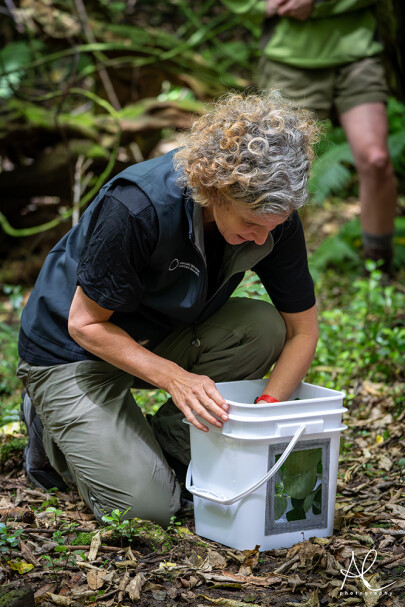
Corinne Watts at Rotokare. Image: Adrian Cleary, Rotokare Sanctuary
About 100 critically endangered Mahoenui giant wētā were released into the Rotokare Sanctuary in Taranaki in late November 2025 as part of multi-agency efforts to preserve this taonga species. Despite being one of the world's largest insects - females weigh in at about 25 grams and are about the size of a mouse - they are vulnerable to mammalian predators. First discovered during the 1960s in remnant tawa forest at Mahoenui in the King Country, the wētā was later found cannily taking refuge from predators in thick gorse. Corinne Watts of the Bioeconomy Science Institute is an expert in the Mahoenui giant wētā and was the technical lead for the wētā translocation to Rotokare. She joined staff from DOC, Rotokare Sanctuary, and local iwi representatives for the release. Translocated populations of the wētā have only survived in predator-free environments similar to Rotokare, at Sanctuary Mountain Maungatautari, Mahurangi Island off the Coromandel, and on private land at Warrenheip, near Cambridge.