Acquired using aircraft flying high-resolution aerial photography, each image (A) has an incredible 2 cm pixel resolution. The tree crowns are outlined (B) and deep learning is used to copy training examples (C) for determining tree species. A complete map of tree crowns by species is then produced (D). The technology is now being used to map individual tree species over large areas of indigenous forest.
Anchor Island is a predator-free sanctuary at the mouth of Dusky Sound, and a haven for the critically endangered kākāpō. Over one million indigenous trees have been mapped on Anchor Island, of which 160,000 have been identified as rimu, a preferred food source for kākāpō.
DOC is using this information to determine the environmental carrying capacity for kākāpō, to guide future conservation management on the island and – as the bird population recovers – on the mainland too.
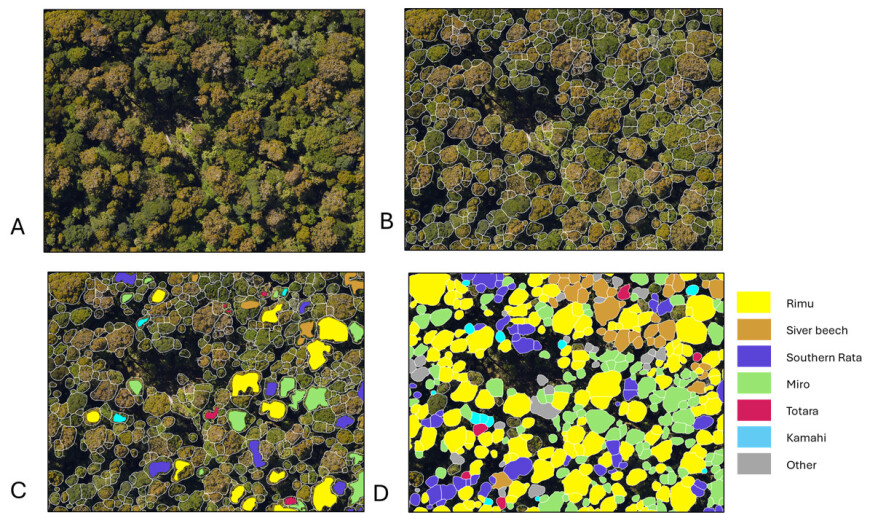
A: Tree crowns at 2 cm pixel resolution. B: Crowns outlined by AI. C: Deep learning used to copy training examples for species identification. D: Complete map produced.